
Knowledge to Action Framework
A framework for understanding how knowledge can be developed, adapted and used in practice.

How we use the framework
The Knowledge-to-Action (KTA) framework helps us explore a project’s context, identify implementation needs and plan next steps. It brings together knowledge creation and an action cycle that supports putting knowledge into use.
During an initial support meeting, we consider where your project sits in the cycle and what support may be useful.
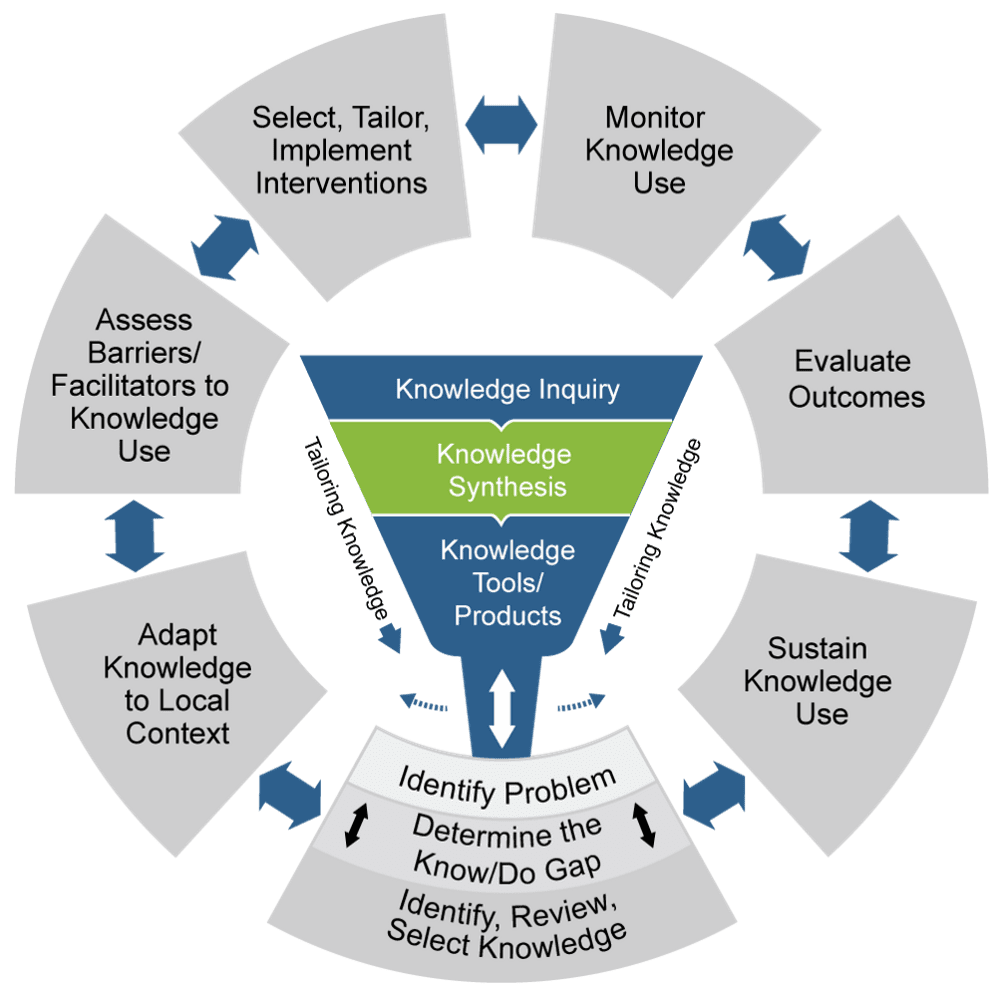
Knowledge creation
Research evidence is developed, brought together and shaped into knowledge, tools or products that people can use. This includes knowledge inquiry, knowledge synthesis, and the development of knowledge tools and products.
The action cycle
These stages guide the discussion and can be revisited as a project develops.
| Identify the problem | Clarify the gap between what is known and what happens in practice. |
| Adapt knowledge to context | Consider how the evidence fits the local setting and the people involved. |
| Assess barriers and facilitators | Identify what may help or hinder the use of knowledge. |
| Select, tailor and implement | Understand whether and how the knowledge is being used. |
| Monitor knowledge use | Assess what has changed and whether the intended outcomes are emerging. |
| Evaluate outcomes | Assess what has changed and whether the intended outcomes are emerging. |
| Sustain knowledge use | Plan how useful changes can be maintained over time. |
Contact the KM team
For initial advice or to discuss your project, email ARCNWCKM@lancashire.ac.uk.


